
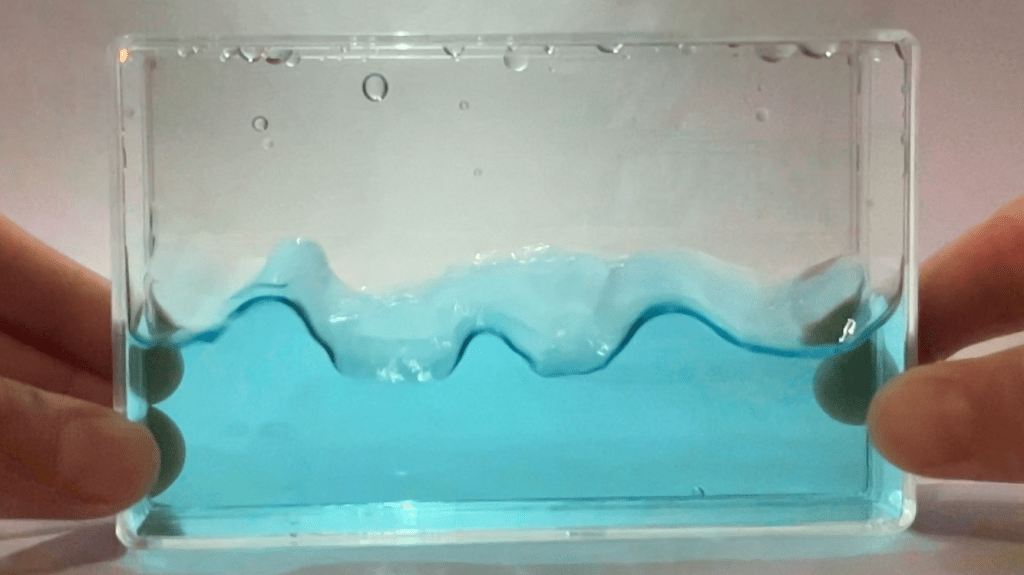
Super Tiny Wave Tank Experiment and Tutorial
I built quite a few of these 4.3 x 2.7 x 1 inch (a little less than a pack of index cards) wave tanks out of acrylic boxes from Amazon, clear silicone sealant, a little bit of food coloring, and of course, water. Construction information coming later.
During our experiment at the end of class, we shook these around in different waves to see how we could recreate different wave patterns. Slow motion videos are your friend! It can be hard to notice everything real time.
The types covered are simple harmonic waves, rogue waves, tsunami-like displacement, breaking wave patterns.
Simple Harmonic Waves
Definition: Harmonic waves are waves with frequencies that are multiples of the fundamental frequency. In harmonic waves, you can see “nodes” (highlighted yellow in slideshows) where there is no displacement.

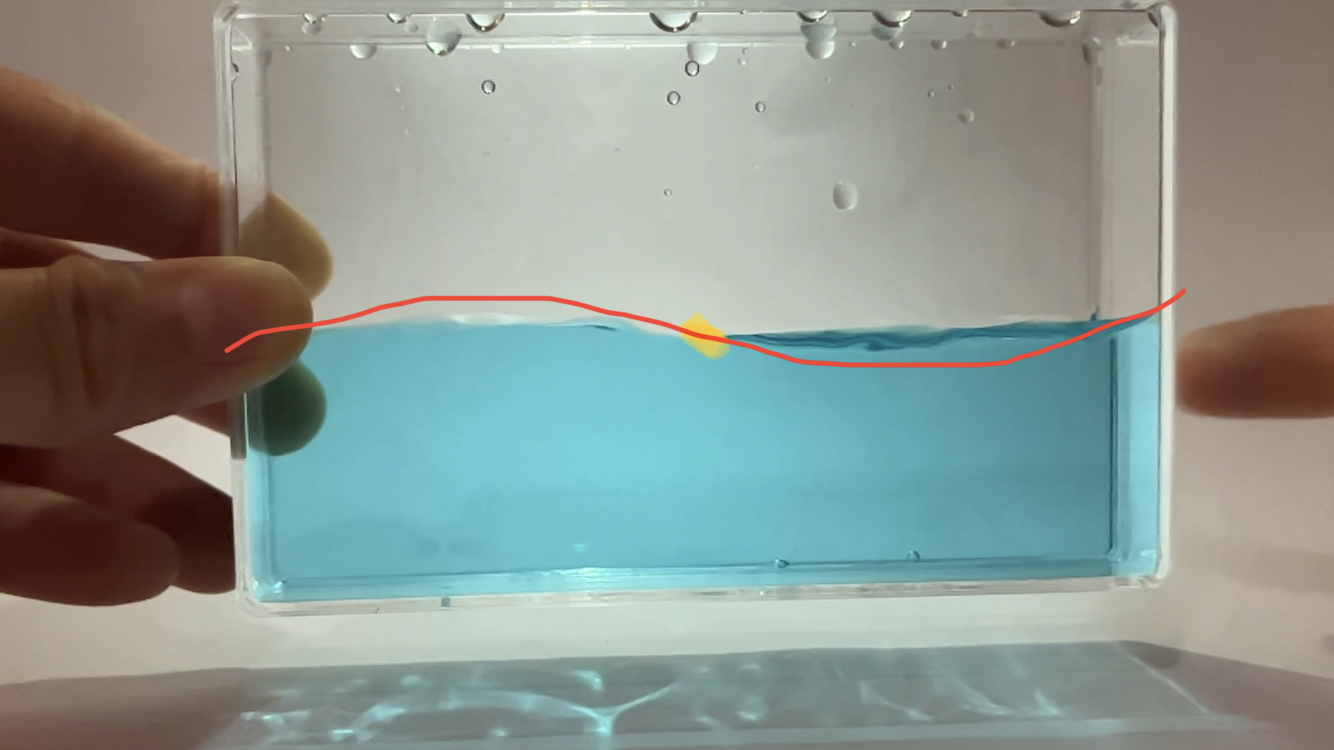
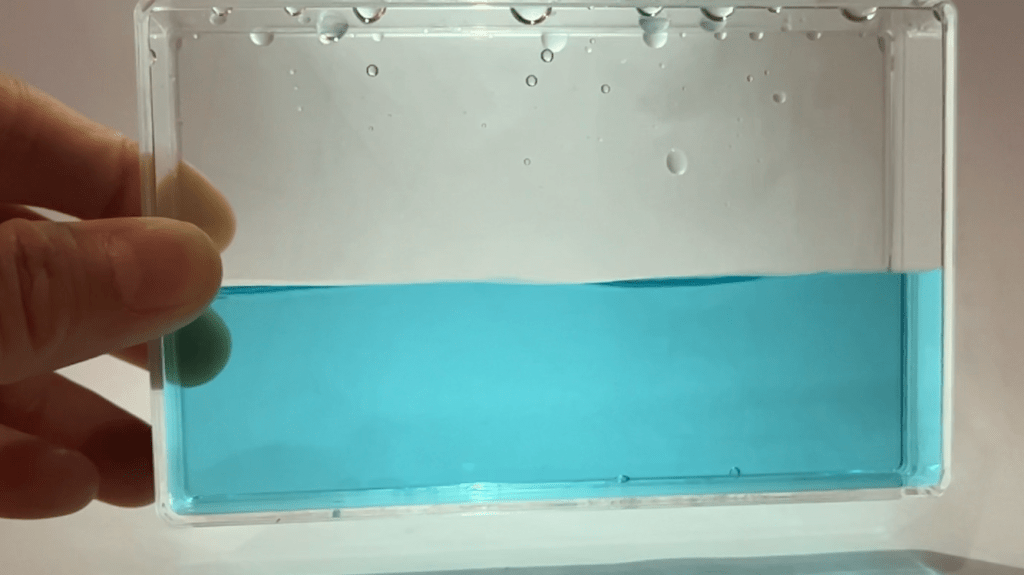
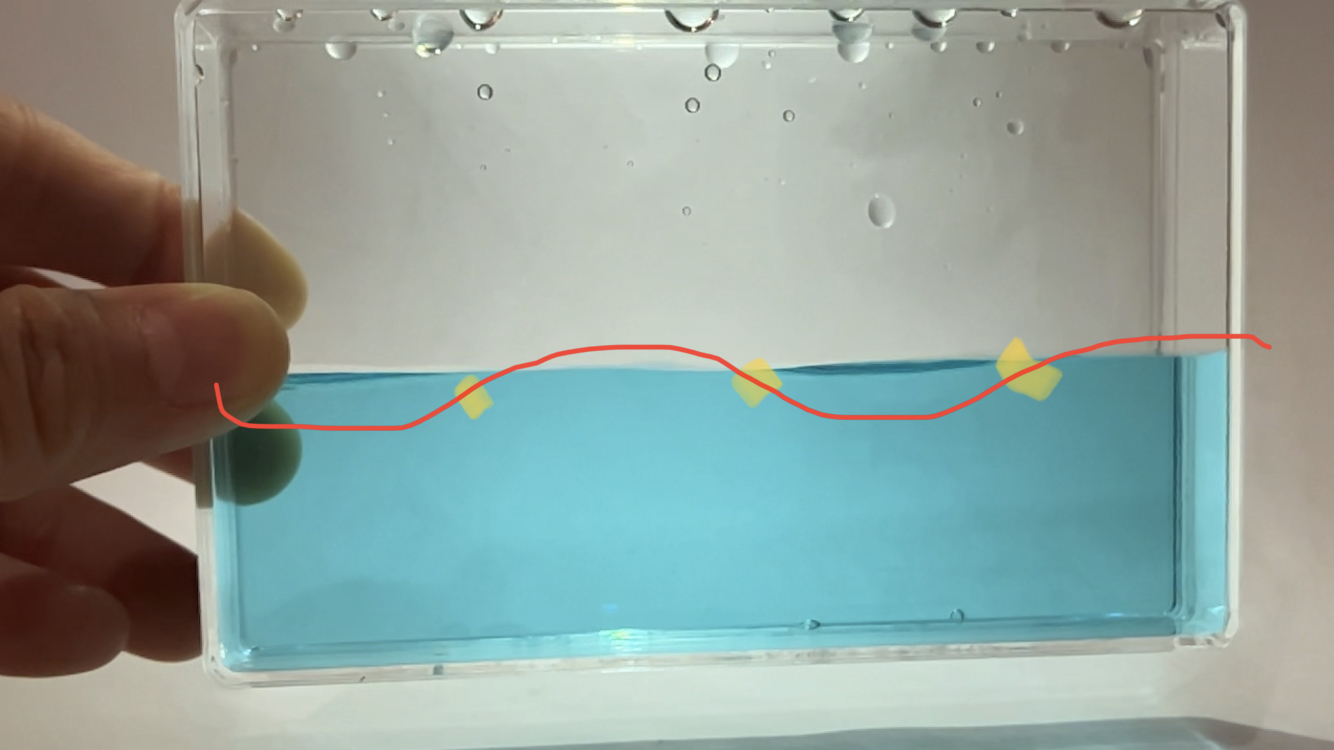
For me, the 2nd and 4th harmonics were the simplest waves to create. While holding the other side of the tank to keep it stationary, I tapped one of the sides at regular intervals. Try tapping it at different speeds! Do you tap it faster or slower to create the 4th harmonic than the 2nd harmonic?
Consider: how else can we produce harmonic waves? Some solutions are in the video. Another case study and different video near the end as well.
An interesting phenomenon I wanted to highlight is the internal orbital wave effect at around 0:10 to 0:16.
This means if you tracked a point on the surface as it moved around the water, it would move in a circular “orbit” and eventually end up in the same spot it began in.
This website has an excellent graphic and explanation of orbital waves!
Tsunami-like Displacement Wave
Definition: Tsunamis are waves caused by a large displacement of water; oftentimes they are caused by earthquakes or underwater volcanic eruptions.
Here’s the video we watched in class compared to this displacement video I created. This is shot in slow motion! It really helps when you’re trying to notice the wave interactions with each other.
You can see the wave displacement immediately because the container is being moved and the water is trying to resist the movement.
It’s also interesting to note the reflection of the wave on the edge opposite to the tap.
Rogue Waves
Definition: any waves that are more than twice the height of the surrounding waves. They form due to constructive interference.
I actually captured this baby sized rogue wave by chance – it happened so quickly in real time that I didn’t realize it occurred, and I only discovered it through watching and scrubbing through the slow motion video!
You can really see in the slideshow the peaks (highest points) of the waves moving closer before colliding and forming the rogue wave.
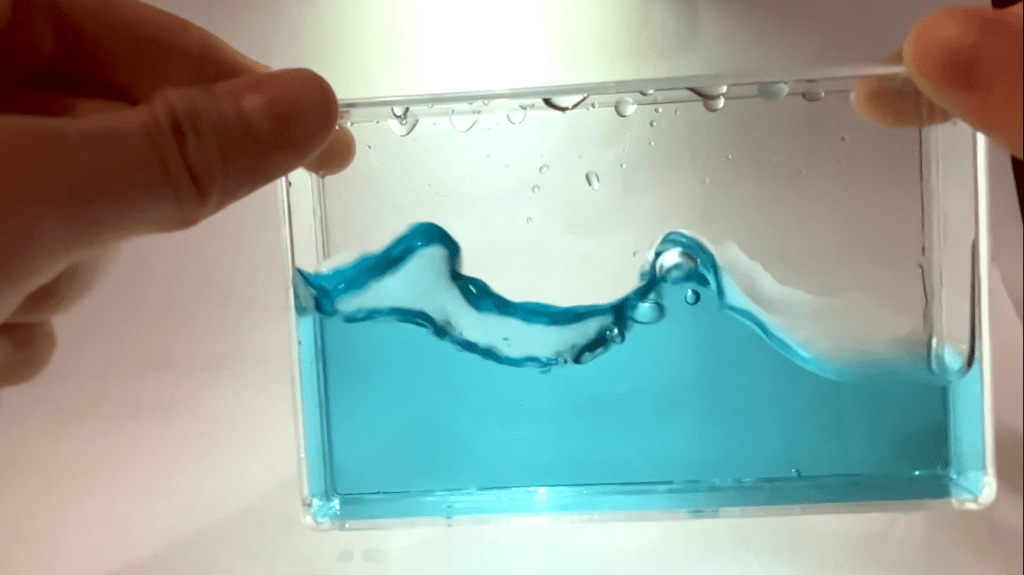

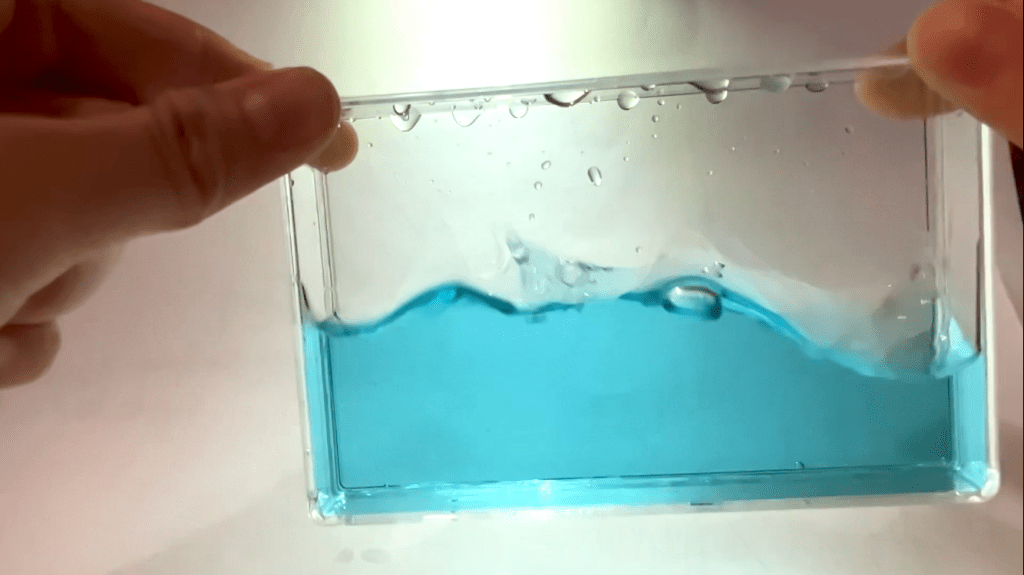
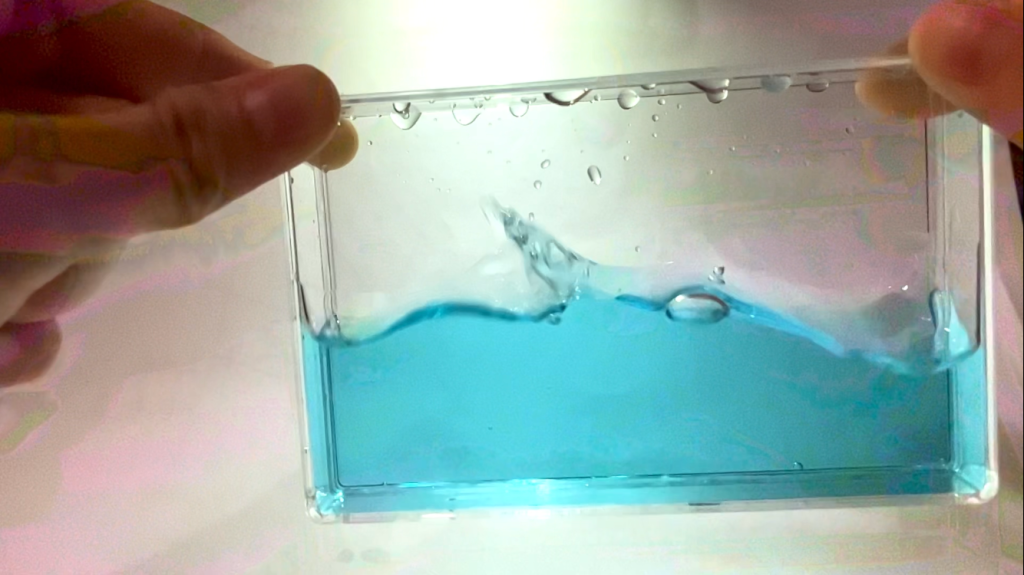

I highly recommend slow motion video for the constructive interference experiments. There’s a more in depth exploration of this below with some questions to think about (answers at the end).
If you’re curious about rogue waves, I have a somewhat detailed post and graphic on this topic because I love it!
Bonus: Capillary Waves
Definition: Capillary waves (which we might also call ripples) are primarily dominated by surface tension, unlike the large scale water waves we think of when we envision the ocean.
We interact with these daily; when the surface of your glass of water is disrupted by putting a pencil on your desk, capillary waves are forming and bouncing around your cup. These are easiest to see by tapping once on the side of the tank (perhaps sideways with the largest face on the table).
Rogue waves, breaking waves, and more ways to create harmonic waves.
Answers to questions are listed in the next block!
Breaking Waves and Rogue Waves
In the first two or three seconds of the video, you can see a classic “breaking wave” shape being formed at the edges of the wave tank (it may help to watch it on 0.5 speed).
Why do you think that is? Consider also the rogue wave: what’s different causing it than the other waves?
More on Simple Harmonic Waves
Why do you think it’s difficult to create higher frequency harmonic waves through tapping? Think about the energy transmitted through tapping compared to shaking.
If you play the video at 0.25 speed, you can see the thumbnail picture being generated at around 0:11 – 0:12!
Explanations!
The breaking waves distinctly have constructive interference involved; when played slowly, it’s easy to see in the first 1 or 2 seconds that a consistent, rhythmic tilting pattern helps create similarly sized and shaped breaking waves. The energy reflection off the sides of the container is quite important in creating this phenomenon.
Later in the video though, the shaking pattern becomes more irregular, and it’s the irregular energy waves that allow for two relatively large, similarly sized waves to collide near the middle of the tank to form a rogue wave. The peaks (highest points) and troughs (lowest points) align almost exactly during this process.
The fetch (uninterrupted travel distance) of the wave across the 1 inch gap is much smaller than the fetch across the 4 inch gap, and thus the wave reflection occurs much sooner and the amplitude tends to be higher, which is why it’s easier to see and generate higher harmonic waves.
The energy transferred through wiggling the box is also much higher than the energy transferred through tapping the sides, which is consistent with the appearance of higher frequency harmonic waves.
 sleep fish.